
The unexpected missile attack on a second India-bound ship carrying Russian crude, just three weeks after the first, has complicated matters for domestic refiners. India now counts the Vladimir Putin-led nation as its biggest oil supplier, according to Paris-based market intelligence agency Kpler, and these attacks come on top of US sanctions since December, where vessels that bring crude to India are facing heightened scrutiny. Panama-registered Pollux, which loaded crude at the Sheshkaris oil terminal in the Russian port of Novorossiysk on January 24, was scheduled to deliver the medium, sour Urals grade to Paradip port on February 28.

Releasing a few short videos of the strike, US Central Command Commander Gen Kenneth Mckenzie told reporters at a Pentagon news conference that after the raid, Baghdadi's compound looks 'pretty much like a parking lot with large potholes'.
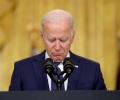
Afghanistan will remain a frontline state for Washington for a foreseeable future in terms of the potential threats to US national security from terrorist groups, asserts Ambassador M K Bhadrakumar, who played a stellar role in beginning India's dealings in Afghanistan in 1994.

'As far as acquisition of Russian equipment is concerned, with about 70% of Indian military equipment being of Russian origin, a sudden decision to abandon imports from Russia is not feasible,' points out Brigadier S K Chatterji (retd).
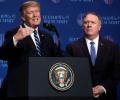
'Traditionally, the US tried to tamp down tensions whenever a crisis situation arose and deputed officials from Washington to travel to Delhi to counsel restraint.' 'This time around, no US envoy flew down to Delhi -- not even when tensions spiked and a flashpoint was reached last week,' points out Ambassador M K Bhadrakumar.

The plan hinged on two critical assumptions: India would not be able to replenish supplies quickly to launch a counter-attack. India could not respond in enough strength to dislodge the Pakistanis. Both assumptions would be proved wrong due to the ferocity of the Indian response, reveals former RAW officer Tilak Devasher in his new book, Pakistan At The Helm.
